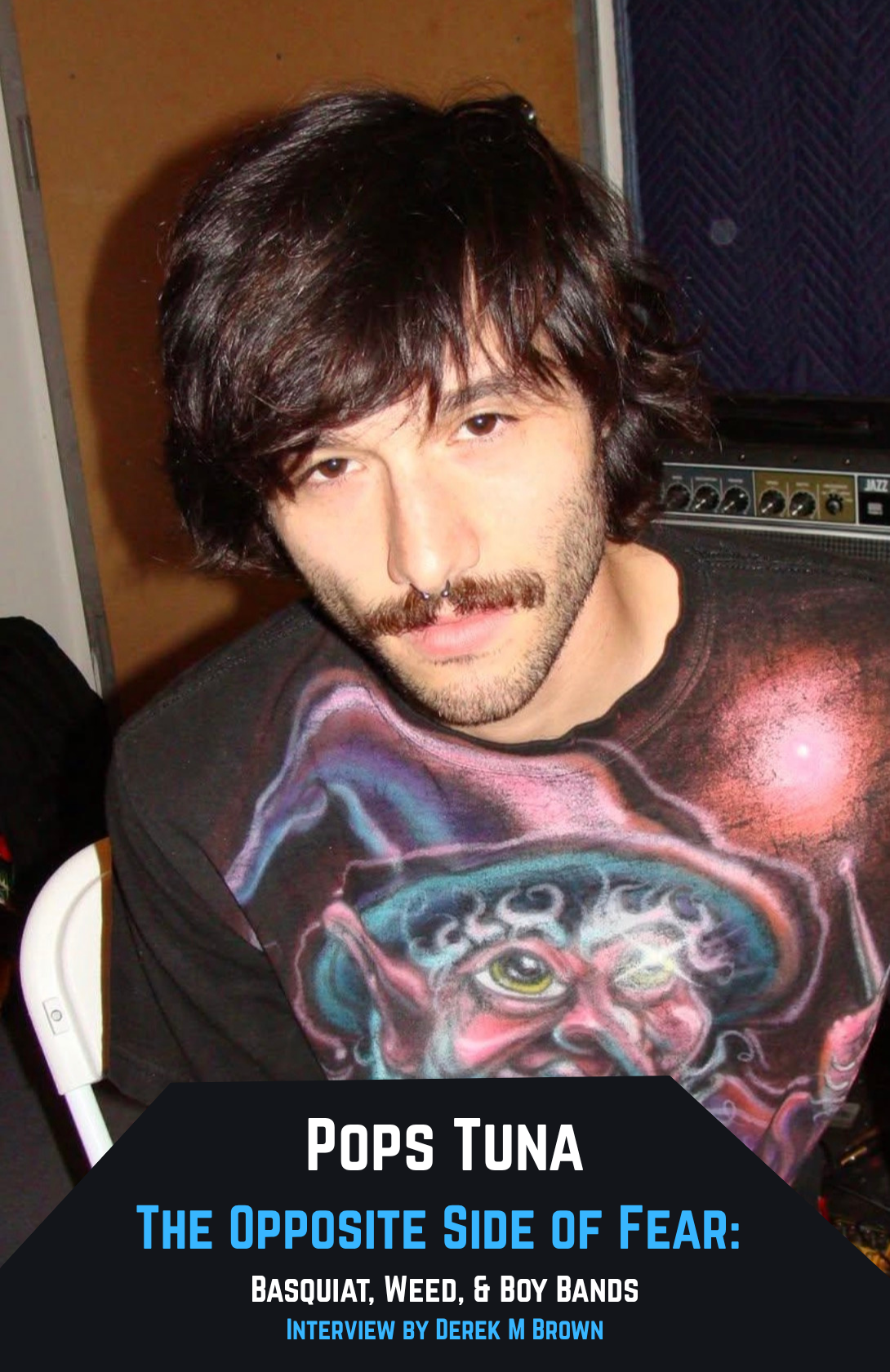
Pops Tuna
The Opposite Side of Fear: Basquiat, Weed, & Boy Bands
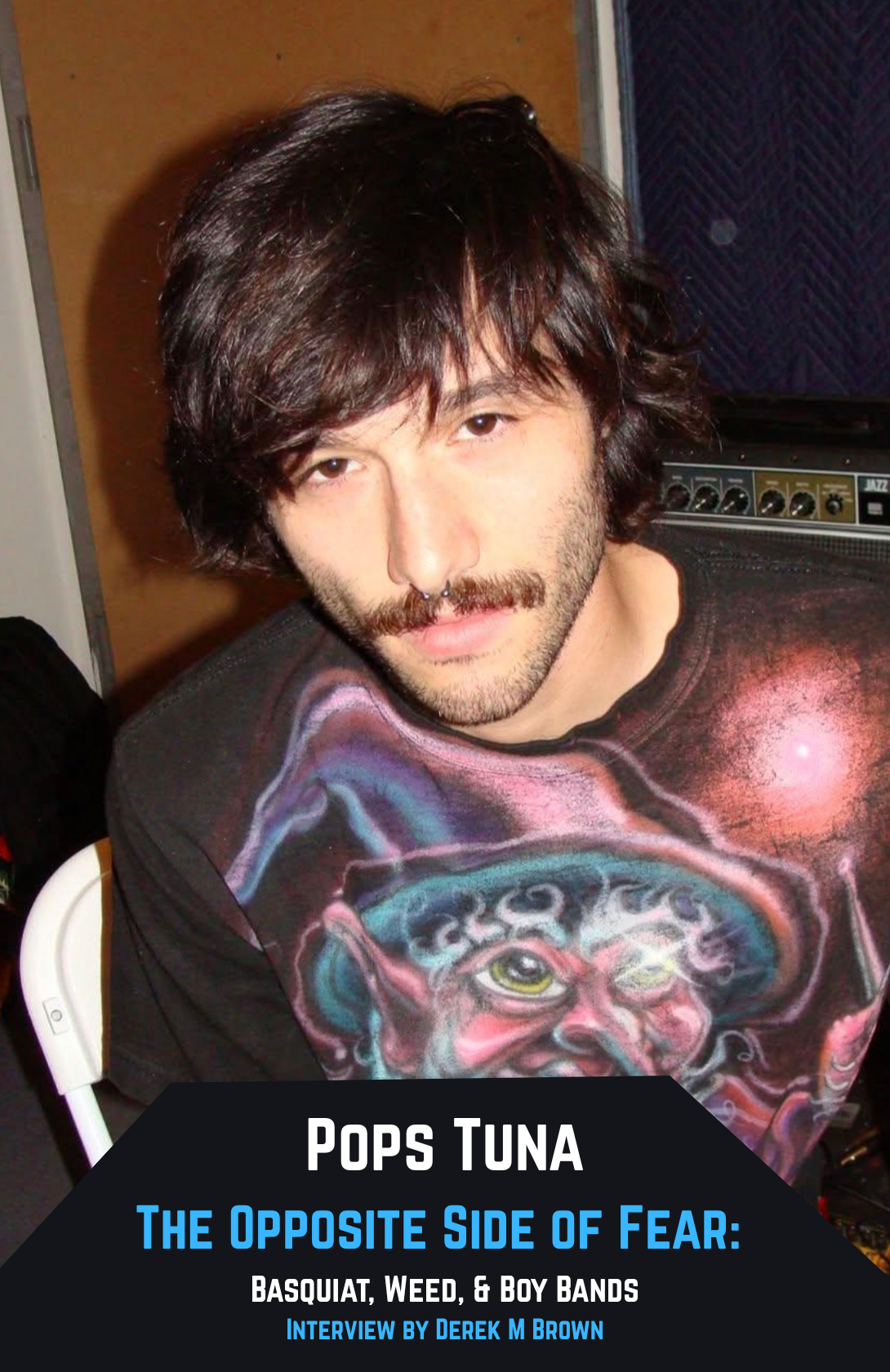
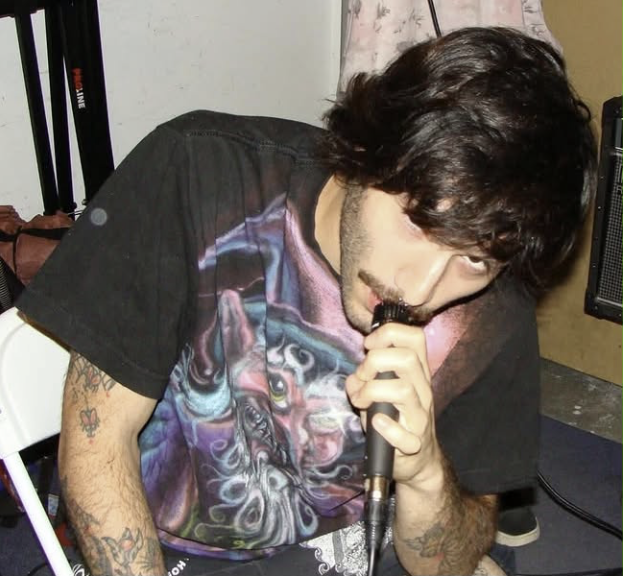
Joseph Mayo is a Philadelphia-based singer, songwriter, multi-instrumentalist, and visual artist who has released over 100 songs as Pops Tuna since the project’s inception.
Themes of shame, alienation, and unrequited longing are explored by a voice that is, by turns, an intimate croon and flesh-tearing cri de cœur, with a genre-defying musical palette beneath that ranges from distorted, lo-fi urgency to languid, jazz-brush clarity.
Loath as I am to draw comparisons, it’s hard not to liken his furious output to Dylan’s, or to recount all of the celebrated musicians who were also highly skilled visual artists, or to acknowledge just how many iconic frontmen also got their start behind the drums before discovering their voice. But Pops Tuna is the vehicle of an artist determined to live and create authentically. Still, he’s not averse to sampling, or gesturing at, his musical forebears. But the results are never a pastiche—they are entirely his own.
I see your father played guitar on a recent song and created a music video for you. That speaks well of your relationship. Have your parents always supported your creative ambitions?
From the beginning, my parents were supportive of my music and art. My dad is a painter, illustrator, and musician himself. He taught me early on how to view the world through an artistic lens. He would always tell me to draw without the expectation of it being perfect. My mom is a teacher, so her persistent encouragement and support for learning played a huge role in my journey. Everyone is born an artist, but society tends to discourage your ability to be free with your art and conforms you to be perfect. My parents gave me the freedom to experiment and create without that pressure.
In “Skullboy” you sing, “I just wanna drive in my car with the music on.” That’s not an experience I associate with city living. How would you describe the area you’re from?
Driving around with the music on always felt like an escape. Music has always been the one place where I get to feel normal. I was born and raised in New Jersey, about 10 minutes from the beach. I've always considered myself a Shore kid at heart. The area I grew up in was also surrounded by the Pine Barrens, but very suburban and somewhat normal. Most people weren't doing anything outside of the box. I always felt out of place. I didn't feel like I fit in until I moved to the city. Truthfully, I still don't feel like I fit in.
When I discovered your music, your Bandcamp bio said, “Weird songs I made using my mac. Thanks for listening.” This reflects some humility if not insecurity. But it now says, “Everything you desire is on the opposite side of fear.” Have you since experienced a breakthrough? A recent release like “Stars,” which has a much more optimistic quality, suggests a shift.
The bio on my Bandamp was the first thing I came up with when I uploaded my first songs for this project in 2020.
I had a pretty big breakthrough recently. I used to only make music when I was experiencing intense sadness, which was a lot. I've always been an extremely emotional person and music helps me process those feelings. For the first time in a long time, I'm very happy, so I’m trying to make music that expresses that part of myself instead of the darkness. My girlfriend told me the quote, "Everything you desire is on the opposite side of fear,” and it really connected with me. I saw the truth in that statement. All the best moments of life come from when you confront something that scares you.
In “Stars” you also sing about walking the tracks at 17 and not recognizing visions, so you start smoking weed, which might suggest it allowed you to access a different part of yourself. Do soft, mostly legal and recreational drugs play a part in your creative process? And what does that process look like? Does it begin with melody or lyrics?
Yeah, I love weed. I’ve been smoking less just because I'm not as depressed and want to be more aware of my life. However, smoking weed definitely helps me get out of my head when I'm making music. Every song is different. I make so much music in so many different ways that it's hard to really pinpoint the process.
In “Falling Back Into Heaven,” you sing, “I am hopelessly romanticizing my life.” Moving through the world with such artistic impulses, is it hard not to constantly see the world through the lens of an artist cultivating material?
I don’t think it's possible for me not to view the world through an artistic lens. It's honestly not even a choice or something I think about. It's just how I exist and process the world.
I believe you when you say, also in “Stars,” that you don’t want to be anyone else. The examples you offer are Dylan, Willie, and Dolly. But because there’s so much anxiety and embarrassment around emulating someone else, few people address it. But you’ve employed a Dylan-esque approach on occasion, with songs that gesture at the Pixies and Weezer. Who are your predominant influences, past and present?
Throughout my life, my influences have changed so much. There have been some really significant ones, and sometimes I find myself imitating rather than being my true authentic self. “Stars” was me addressing this and trying to motivate myself to focus on what I like, rather than what the outside world wants me to be.
David Bowie has always been a primary inspiration for me. I love his ability to change and shift genres. I like to think that I have done that throughout my career. Whether it's making folk music, indie, punk, dance, or trap, I try to make what inspires me. I'm also a huge Yung Lean fan because I feel he has a similar ability to effortlessly shift genres. Visually, Basquiat is a big inspiration for me, as well as Van Gogh and Picasso. However, the people who inspire and influence me the most are my friends, the Venus Twins, Friend the band, my twin brother, Holy Mountain, Fluey, just to name a few.
Shame, often in relation to embarrassing social interactions, is a recurring lyrical theme. What is your relationship with shame?
I think deep down I'm an extremely shy and introverted person. I put on the mask of an extrovert, but whenever I have a conversation I'm instantly replaying the entire interaction, wondering why I said that thing or questioning if I made a fool out of myself.
Do you spend much time thinking about genre or where you fit?
I try not to think about genre at all. I just make what I like. However, at times I do wonder where I fit in. I feel like my music doesn't really have a place.
How’d you arrive at the name Pops Tuna?
Pops Tuna is a reference to my grandfather, whom I mentioned before. We call him “Pops” and he also loves to make tuna. He labels the container “Pops Tuna,” and when I went to college I put my weed in the container. Whenever my friends and I would go to smoke, we’d laugh because we were smoking Pops’ tuna, thus the name was born. I hope he never finds this out. I think he would be mad.
What is the Tuna Collective? I found an Instagram page promoting Tunaween, various shows, and a graphic novel. How does it fit in with Pops Tuna, if it does? Is community important to you or integral to your conception of creating and sharing art?
The Tuna Collective is a group with my friends from college who were all making music at the time. A few of us had a house together where we would throw shows and screenprint our own t-shirts. I was extremely inspired by the Elephant 6 collective and wanted to do something similar. Music is nothing without community. Being able to share ideas and collaborate with your friends is the whole point of all of this.
I see you also play drums with Disaster Artist Band, which is you and your twin brother, who sings and plays guitar for this project. There’s a tradition of drummers becoming iconic frontmen––Steven Tyler, Kurt Cobain, Chris Cornell, to name a few. Were the drums your first instrument? What would you say your primary instrument is?
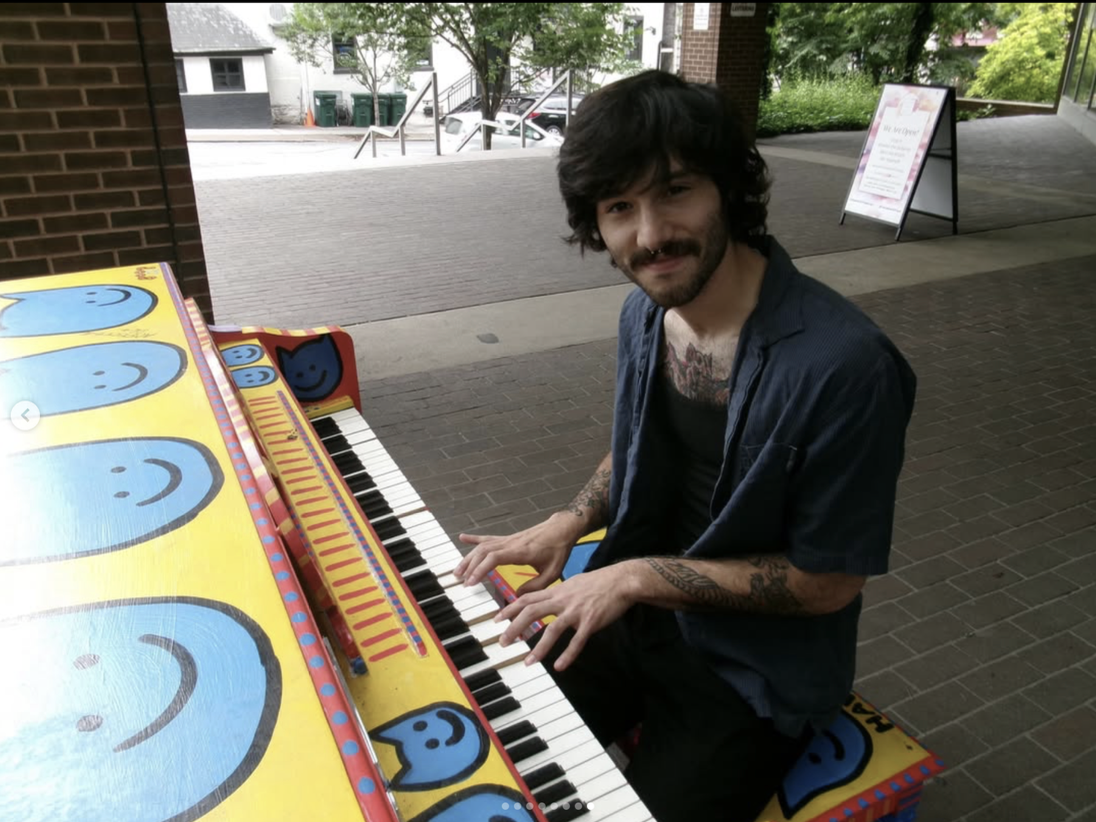
My primary instrument is the drums. I've been playing since I was 6 years old––on and off––but I also love to sing. Nothing makes me feel more alive than getting to sing a song I wrote or play drums with my twin. I didn't start playing guitar and singing until I was a freshman in high school. During those years I was also playing the saxophone, but never felt creatively fulfilled. I decided I wanted to write songs and realized rather quickly you couldn't do much with just the drums.
Some of the greatest songwriters and musicians are also very gifted visual artists. E.g., John Lennon, Bob Dylan, Kurt Cobain. Does your visual art come from the same place as your music? Do you consistently work in both mediums, or do you alternate between them? Do you ever feel split between being a visual artist and musician? Do you alternate between these mediums, or are you consistently engaged in both?
You would be hard-pressed to see me without a pen in my hand. I’m always drawing. I probably started drawing before I started making music. I think music and art are pretty tied together for me. They are just two different ways I express myself. The music comes more from the heart and the physical art is more of a brain dump of emotions. I feel split between both sometimes and it's hard to know which one I should be devoting myself to more. There have been plenty of times where people have told me to give up music to draw, but, truthfully, I couldn't live without either. Sometimes, I wish I had devoted more time to one so I would have mastered it by now, but I find immense joy in both.
You’re also in a boy-band, iluvboyband, which consists of two sets of twins. You guys seem to have a lot of fun, and it’s hard to know how much of it is tongue-in-cheek. But you guys also opened for Boys Go To Jupiter, a band with 40k followers. Is this project more of a purposeful vehicle for mainstream success?
The boyband is the most fun project I have ever been a part of. It started as a way for us to make the music we were dying to make. I always wanted to rap and make trap beats but was too scared of ridicule until my friends gave me the courage. That part of myself has lain dormant for a very long time. It was not a purposeful vehicle for mainstream success because both of our bands were noisy punk projects and we knew that this boyband would alienate a lot of our listeners, but I've always been compelled to follow my heart with music. However, we have had a lot of cool opportunities through it and the whole experience has been super exciting. We have a lot of really cool stuff still on the way that I cannot wait to share.
If we could talk about your recording process, do you usually collaborate with others, or is it often just you at your computer playing all of the instruments?
Some of my albums are done solo and some feature help from friends. For example, I play all the instruments on my newest record, Slacker, but my self-titled record, Pops Tuna, features a ton of collaborations.
What DAW do you use, and how proficient are you in home recording? Have you developed a gear lust, or could you care less about microphones and preamps?
My twin and I have a pretty extensive collection of gear at this point. We’ve been collecting instruments and microphones throughout the years, but I do tend to go back to a pretty simple setup. I use Logic Pro, and a lot of my recordings are just vocal takes directly into the MacBook speakers. I care more about the energy of the performance over what gear was used.
How often do you have a sound in mind that you’re chasing versus accidentally arriving at something that you’re struck by and keep?
I think I'm always chasing a sound I’ll never get, and everything I've ever made has just been an accident.
Do you mix and master the songs yourself?
I mix most of my music and master some of it. It really depends on the project.
“Cemetary” was the first song of yours I heard. It’s unlike anything I’ve come across recently. “If only it were easier to be real” is such a great lyric and everything works so well to complement everything else and produce something as beautiful as it is heartbreaking (although I do want it to be longer). Can you tell me who’s playing what and how the piano melody was arrived at?
Cemetery was created by me and the drummer from the band Friend, Aubrey. He’s playing the piano and guitar and I'm singing and playing drums. We recorded an improv jam and ended up with an instrumental version of the song. When he left, I did the vocals and, when I shared it with him, he added the line “if only it were easier to be real,” which finished the whole song. Aubrey also wanted the song to be longer, but I was intent on keeping the original take. I like keeping the magic from the first moment it was made. I don't like to go back and redo songs.
How do you discover music? Bandcamp, Spotify, YouTube Music? Where do you spend the most time sharing and promoting your music?
I find a lot of my music through friends or online. If I see something I like, I'll usually do a deep dive, but it's rare I find something that really connects with me. I promote most of my music on Instagram, although I’ve been promoting it less over the years.
What are your professional ambitions? What does success look like?
I’d love to be touring more and getting my music to new places. If I could live solely off the music, I'd be happy.
Who should our readers listen to, if you could recommend a few artists or albums?
My favorite albums are Love Songs For Teenagers and Beautiful Feeling by Holy Mountain, Starz by Yung Lean, Castles by Lil Peep, This Old Dog by Mac Demarco, Dirt Buyer by Dirt Buyer, Transformer by Lou Reed, Slide by George Clanton, Raxis by the Venus Twins, The Rise and Fall of Ziggy Stardust by David Bowie, Joshua Tree by U2. It’s unreleased, but when it’s out, find This Machine Makes Friends by Friend and Eternal Youth Forever Land by Chris Mayo Songs. Tetsou Shima by Jaces Phantasm is a masterpiece. This Is The Day by The The.
Is there anything you’ve said here that your twin would call bullshit on?
My twin calls me out on my bullshit all the time and I call him out on his. It's how we stay grounded.
Interview by Derek M Brown (db Sound Production Lab)